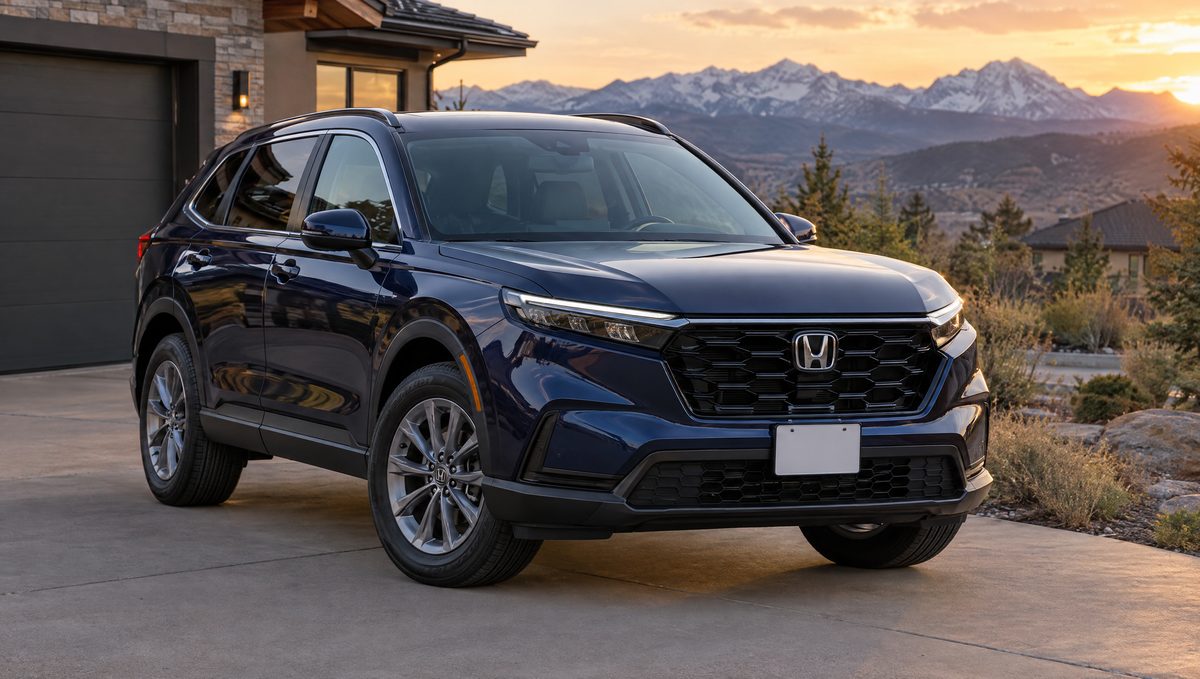
Honda CR-V review for Colorado buyers
The CR-V is roomy, efficient and easy to live with, and the 2023 and newer Hybrid is the strongest version for Colorado, with 204 hp and 37 mpg combined in AWD form. It isn't a mountain specialist: ground clearance is 7.8 to 8.2 inches on current models, Real Time AWD is optional on most trims, and hybrid towing tops out at 1,000 pounds. On 2017-2018 1.5-liter turbos, check for oil dilution history before you buy.
AI-generated illustration of a Honda CR-V, not a specific vehicle for sale.
Verdict
- Commuters who want a roomy compact SUV with strong hybrid mileage
- Front Range drivers who mostly stay on plowed roads
- Families who need rear-seat and cargo space in a compact footprint
- Buyers who want a 2023 or newer hybrid with a Snow drive mode
- You need to tow more than 1,500 pounds
- You drive unplowed or rutted roads often
- You're looking at a 2017-2018 1.5T with no service records
- You assume every CR-V has AWD
How it fits Colorado
Scored 1 to 5 for the way people here actually drive. These are our judgments, based on the facts below. Select a rating for the reasoning.
-
Real Time AWD (optional on most trims) and, on 2023+ hybrids, a Snow mode work well on plowed highways with proper tires, but clearance is lower than Subaru rivals.
-
The 1.5-liter turbo and the 204 hp 2023+ hybrid both handle grades better than the older 2.4-liter non-turbo engines.
-
Honda rates gas 1.5T models at 1,500 pounds and 2023+ hybrids at 1,000 pounds.
-
Ground clearance is 7.8 inches on front-drive and 8.2 inches on AWD 2023+ models, and the 2026 TrailSport doesn't raise it.
-
EPA rates 2023+ hybrids at 37 to 40 mpg combined and 1.5T models at 28 to 30.
-
Five seats and 39.3 cubic feet of cargo space behind the rear seat on 2023+ models, with 76.5 cubic feet folded.
Which CR-V generation to look at
6th generation 2023-present
Redesigned for 2023 with a 190 hp 1.5-liter turbo on non-hybrid trims or a 204 hp two-motor hybrid on Sport trims. Honda added a Snow drive mode to the hybrid, and a TrailSport hybrid joined for 2026.
- Recall 23V588: some 2023 CR-V Hybrids may have an improperly manufactured electronic transmission that can cause loss of drive power
- Recall 24V745: high-voltage battery modules on some 2023 hybrids may have been built incorrectly, allowing a terminal or busbar to break and spark
- Recall 24V744: the steering gearbox on some 2023-2025 models can develop excessive internal friction and make steering difficult
- Recall 24V763: high-pressure fuel pump may crack and leak on some 2023-2025 hybrids
- Recall 23V092: front passenger seat back frame welds on some 2023 models
5th generation 2017-2022
Introduced the 190 hp 1.5-liter turbo (EX and up) alongside a 184 hp 2.4-liter on LX models through 2019. The first CR-V Hybrid arrived for 2020 with 212 hp and standard AWD.
- Oil dilution on 2017-2018 1.5-liter turbos: Honda issued software updates in cold-weather states and extended warranty coverage on certain 2017-2018 CR-Vs to six years with unlimited miles; that window has now closed for nearly all of them
- NHTSA opened an investigation in 2022 into unexpected automatic emergency braking on 2017-2019 CR-Vs and expanded it in 2024 to 2020-2022 models; check nhtsa.gov for current status
- Recall 19V865: rear subframe bolts on some 2019-2020 models may loosen
- Recall 18V663: a power steering torque sensor magnet on some 2017-2018 models may come loose
- Hybrid recalls 20V798 (2020 DC-DC converter can stop charging the 12-volt battery) and 23V844 (2020-2022 12-volt cable missing a fuse)
4th generation (refreshed) 2015-2016
A 185 hp direct-injected 2.4-liter replaced the old engine and the five-speed automatic gave way to a CVT for 2015. Real Time AWD was optional.
- Recall 17V305: some 2015-2016 CR-Vs that received a replacement engine may have been built with the wrong pistons
- Check for completed fuel pump recall 23V858, which covers a wide range of Hondas including the CR-V
- Older age means rubber, suspension and brake wear matter more than model-year quirks
Honda CR-V specifications
Figures vary by year, trim and configuration. Confirm the exact numbers for any specific vehicle before you rely on them.
- Drivetrain
- FWD or Real Time AWD (AWD standard on 2020-2022 Hybrid and on some 2023+ trims
- Varies by trim)
- Engine(s)
- 2.4L four (185 hp 2015-2016, 184 hp 2017-2019 LX)
- 1.5L turbo four, 190 hp (2017+)
- Hybrid with 2.0L engine (212 hp 2020-2022, 204 hp 2023+)
- Transmission
- CVT on gas models
- Two-motor hybrid system (E-CVT) on hybrids
- Ground clearance
- 7.8 in FWD / 8.2 in AWD (2023+)
- Seating
- 5
- EPA fuel economy (combined)
- 27-40 mpg, varies by year and powertrain (2.4L AWD 27-28, 1.5T AWD 28-29, hybrid AWD 35-38, hybrid FWD 40)
- Towing (max, properly equipped)
- 1,500 lb on gas models
- 1,000 lb on 2023+ hybrids including TrailSport
The CR-V for Colorado buyers
Hybrid or 1.5 turbo for Colorado
On 2023 and newer CR-Vs, the hybrid is the one we'd point most Colorado buyers toward. It makes 204 hp combined, with 247 lb-ft from the electric motor, versus 190 hp and 179 lb-ft for the 1.5-liter turbo. EPA rates the AWD hybrid at 37 mpg combined versus 28 to 29 for the AWD turbo.
The turbo still has a place. It's rated to tow 1,500 pounds versus 1,000 for the hybrid, and on 2017-2022 models it's the engine most CR-Vs have. Turbocharged engines also hold their power at altitude better than the older non-turbo 2.4-liter.
On 2020-2022, the first CR-V Hybrid makes 212 hp and comes with AWD, rated at 38 mpg combined. It's a good used buy, but check that recalls 20V798 and 23V844, both tied to the 12-volt system, were completed. You can browse current CR-Vs in our inventory.
The 2017-2018 oil dilution story
Early 1.5-liter turbo CR-Vs drew complaints that fuel was getting into the engine oil, raising the oil level. Honda framed it as mostly a cold-weather problem, which is why it matters here. Honda issued software updates for cars sold in cold-weather states and extended coverage on certain 2017-2018 CR-Vs to six years with unlimited miles for parts including the camshaft and rocker arms.
That six-year coverage has now run out on nearly every affected car. If you're shopping a 2017 or 2018 1.5T, ask for proof the software update was done, look at oil change frequency in the records, and check the dipstick for an overfull level. A car with frequent oil changes and the update is a reasonable buy; one with no history is a gamble we'd skip.
Not sure how to judge a specific car? That's what we do. See how our buying process works or contact us with a VIN.
Snow, Real Time AWD and the Traction Law
Real Time AWD is Honda's on-demand system: it sends power to the wheels with grip when the front tires slip. It's optional on most CR-V trims, so front-drive CR-Vs show up in every model year. If you'll be in the mountains, filter for AWD.
For 2023, Honda added a Snow drive mode to the hybrid, working with the updated Real Time AWD on Sport AWD and Sport Touring models. It's a useful addition for icy Front Range mornings.
Whatever you buy, CDOT's Traction Law on I-70 between Morrison and Dotsero (September 1 through May 31) requires tires with at least 3/16 inch of tread and a winter, all-weather or M+S rating, or chains or an approved device. Our guide to buying a used car for Colorado winters explains what to check.
Clearance and towing: know the limits
Honda lists 7.8 inches of ground clearance on front-drive 2023+ CR-Vs and 8.2 inches on AWD models. That's fine for plowed roads and most driveways, but it's less than the 8.7 inches on every Subaru Forester or Outback, and it shows on rutted, snow-packed side streets.
The 2026 TrailSport hybrid adds its own styling and equipment, but published specs show it keeps the same roughly 8.2 inches of clearance and the same 1,000-pound tow rating as other hybrids. Don't buy it expecting a lifted CR-V.
For towing, gas models are rated at 1,500 pounds, which covers a utility trailer or small pop-up. If a camper is in your plans, read towing a camper in the mountains and consider something with a higher rating.
What to check on a used CR-V
On 2017-2022 models, NHTSA's investigation into unexpected automatic emergency braking is worth knowing about. It started in 2022 with 2017-2019 CR-Vs and was expanded in 2024 to include 2020-2022 models and upgraded to an engineering analysis. Check nhtsa.gov for the latest status and any resulting recall before you buy.
On 2023 hybrids, confirm recalls 23V588 (electronic transmission) and 24V745 (high-voltage battery modules). On 2023-2025 models, the steering gearbox recall 24V744 matters too: difficulty steering is not something you want discovered on a mountain road.
Last, check for hail repair and paint work, a normal step for any used car in Colorado. Our hail damage guide covers what to look for.
Pros and cons
- 2023+ hybrid makes 204 hp and is rated 37 mpg combined with AWD
- Roomy cabin and 39.3 cubic feet of cargo space behind the rear seat (2023+)
- 1.5-liter turbo holds up better at altitude than the older 2.4
- Snow drive mode on 2023+ hybrids
- Wide choice of used model years and trims
- Lower ground clearance (7.8 to 8.2 inches) than Subaru rivals
- AWD is optional on most trims
- Hybrid tow rating is only 1,000 pounds
- 2017-2018 1.5T oil dilution history needs checking, and the extended coverage has expired
- Open NHTSA braking investigation on 2017-2022 models
Looking for a CR-V?
None listed at the moment. Tell us the year range, trim and budget and a broker will look for one that fits.
Honda CR-V questions
Is the Honda CR-V good in snow?
An AWD CR-V on proper tires is good in snow on plowed roads, and 2023+ hybrids add a Snow drive mode. Its 7.8 to 8.2 inches of clearance is lower than Subaru rivals, so deep unplowed snow is a weaker spot. AWD is optional on most trims, so confirm it before buying.
Which Honda CR-V years should I avoid?
The 2017 and 2018 1.5-liter turbo models need the most scrutiny because of oil dilution complaints, and their extended coverage has expired. 2017-2022 models are also part of an NHTSA braking investigation. A 2017-2018 with documented software updates and frequent oil changes can still be fine.
Does the CR-V 1.5 turbo still have oil dilution problems?
The well-documented cases centered on 2017-2018 CR-Vs, mostly in cold climates, and Honda responded with software updates and extended coverage on those years. We didn't find a comparable warranty action for later years. On any 1.5T, check service records and the oil level.
Should I get the CR-V Hybrid or the turbo in Colorado?
For most drivers, the hybrid: on 2023+ models it has 204 hp versus 190, with far more electric torque, and it's rated at 37 mpg combined with AWD versus 28 to 29 for the turbo. Choose the turbo if you need the 1,500-pound tow rating instead of 1,000.
How much can a Honda CR-V tow?
Gas CR-Vs are rated at 1,500 pounds. 2023 and newer hybrids, including the 2026 TrailSport, are rated at 1,000 pounds. Confirm the rating for the exact car in the owner's manual.
Is every Honda CR-V all-wheel drive?
No. Real Time AWD is optional on most trims, so front-drive CR-Vs are available in every model year. The 2020-2022 Hybrid came with AWD, and some 2023+ trims include it standard.
Does the CR-V TrailSport have more ground clearance?
No. Published specs show the 2026 CR-V TrailSport keeps about 8.2 inches of clearance, the same as other AWD CR-Vs, and the same 1,000-pound hybrid tow rating.
Honda CR-V or Subaru Forester for Colorado?
The Forester has standard AWD and 8.7 inches of clearance; the CR-V has a roomier cargo area and a stronger hybrid. If you drive rough or unplowed roads, lean Forester; if you mostly commute on plowed highways, the CR-V Hybrid is hard to beat. Read our Subaru Forester review.
How we review
This is a buyer's review, not a road test. We compile facts from the sources below (manufacturer information, EPA fuel economy data, NHTSA recall records and similar), then add our view as a Colorado brokerage on how the vehicle suits winter, altitude, towing and trail use. Ratings are our editorial judgment. Specifications change by year and trim, so we confirm details for any specific vehicle before you buy. Spotted something wrong? Tell us and we'll correct it.
Sources
- fueleconomy.gov: 2016 Honda CR-V 2WD and 4WD
- fueleconomy.gov: 2019 Honda CR-V AWD (2.4L vs 1.5T)
- fueleconomy.gov: 2022 Honda CR-V AWD and Hybrid
- fueleconomy.gov: 2026 Honda CR-V AWD, Hybrid and TrailSport
- Honda news: 2023 Honda CR-V specifications and features
- Honda news: 2017 Honda CR-V powertrain
- Honda news: 2015 Honda CR-V powertrain
- Carscoops: 2020 Honda CR-V Hybrid (212 hp)
- Honda: CR-V (Snow mode, Real Time AWD)
- KBB: 2017 Honda CR-V specs (towing)
- Motor Illustrated: 5 questions about the 2026 Honda CR-V TrailSport
- Consumer Reports: Honda extends warranty on turbo engines
- Cars.com: Honda extends warranty on CR-V, Civic for 1.5-liter turbo oil issue
- WardsAuto: Honda extends warranty to address 1.5L oil dilution
- Jalopnik: CR-V and Accord investigated for phantom braking
- TFLcar: NHTSA expands Honda phantom braking probe
- NHTSA recall 23V588: 2023 CR-V Hybrid electronic transmission
- NHTSA recall 24V745: 2023 CR-V Hybrid high-voltage battery
- NHTSA recall 24V744: steering gearbox
- NHTSA recall 24V763: high-pressure fuel pump
- NHTSA recall 23V092: 2023 CR-V seat back frame
- NHTSA recall 19V865: 2019-2020 CR-V rear subframe bolts
- NHTSA recall 18V663: 2017-2018 CR-V power steering
- NHTSA recall 20V798: 2020 CR-V Hybrid DC-DC converter
- NHTSA recall 23V844: 2020-2022 CR-V Hybrid 12V cable
- NHTSA recall 17V305: 2015-2016 CR-V replacement engine pistons
- NHTSA recall 23V858: Honda fuel pump
- CDOT: Passenger Vehicle Traction and Chain Laws
Related reviews


